My core research interests are:
(1) Educational implications of the relation between physics and mathematics
(2) Pedagogical potential of the history of physics and mathematics
The following projects illustrate some of the work I’ve been doing.
The complexification of physics
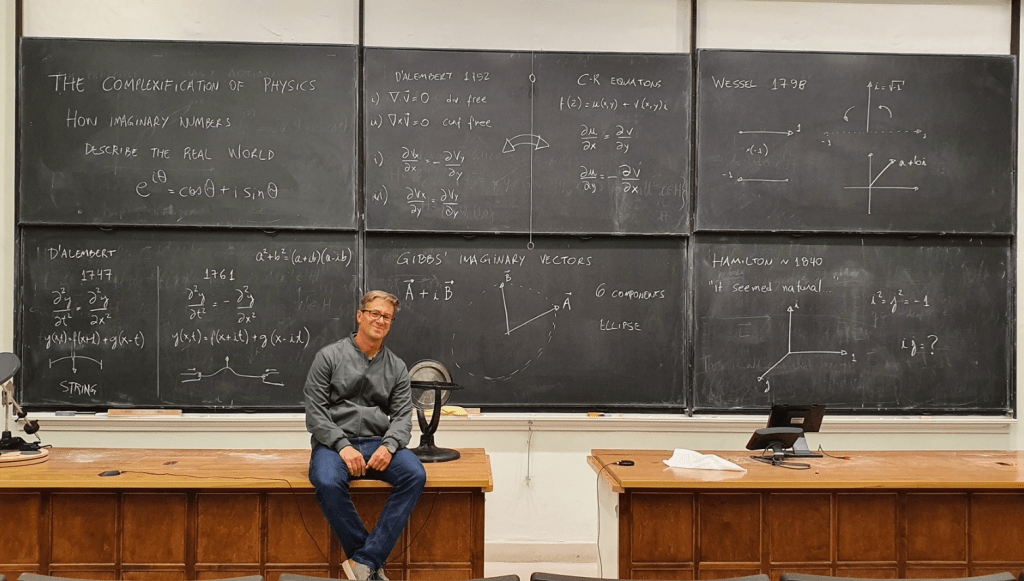
Complex numbers were created (or discovered?) as pragmatic tools to solve cubic equations, and not much attention was given to ontological questions about their “existence”. However, this changed significantly at the end of the 18th century, when they were given a geometrical interpretation. Such concretization motivated physicists to use these numbers to model numerous phenomena, a process that has been called “complexification of physics” by Salomon Bochner.
In this project, various historical episodes are analyzed, highlighting, in each case, how and why complex numbers became useful to physicists. Taken together, these examples provide a nuanced and pluralistic picture of the interplay between mathematics and physics, as well as its educational implications. A monograph on the topic is expected to be published by Princeton University Press in 2027.
AJP publications: Fresnel, Schrödinger’s struggles, QM at intro level
Talk on YouTube: Números complexos na física
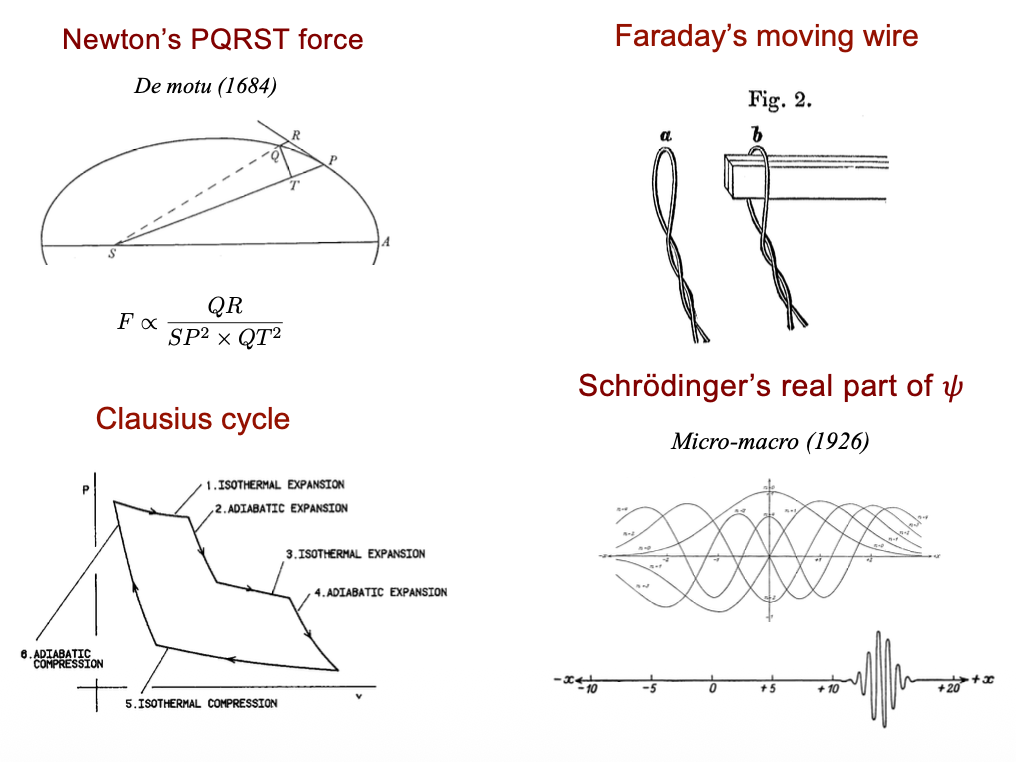
Presentation: Slides with 4 episodes
Original sources in physics teaching
We often teach physics theories as if they were self-evident truths. This is not only demotivating to students, but also prevents them from understanding how new concepts and theories emerge.
This project aims to develop and evaluate teaching materials that give learners a sense of how the theories and concepts they encounter were originally formulated. It includes carefully selecting primary sources and defining clear learning goals. While the approach applies across all areas of physics, it is especially challenging – and particularly meaningful – in the context of quantum mechanics.
Book chapter: Using history of physics to teach physics?
Talk on YouTube: Fontes primárias no ensino de física
Presentations: Original sources in Physics and Quantum mechanics
QED: Understanding and deriving equations in physics education
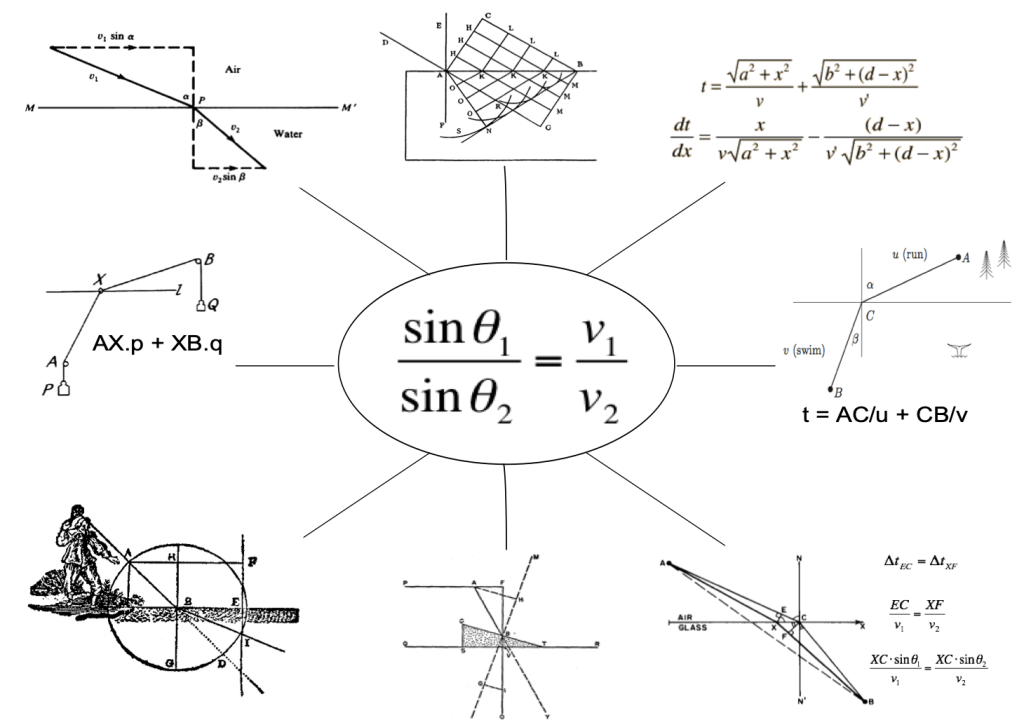
Deriving equations from first principles is central to theoretical physics. In many classroom contexts, however, such derivations are presented simply as linear chains of reasoning whose main purpose is to justify a final formula.
This project advocates a pedagogy of derivations, in which the same formula is obtained through multiple complementary approaches (as illustrated, for example, by Snell’s law). Rather than privileging one “best” derivation, the emphasis is on uncovering the distinct insights each perspective provides.
Paper: QED: Deriving equations in physics teacher education
Presentation: Slides from a talk at GIREP 2014
Teaching the structural role of mathematics in physics
Learning to use mathematics as a means of reasoning about the physical world involves far more than the routine application of mathematical techniques. This raises the question of how students can be taught to appreciate the structural role mathematics plays in physics.
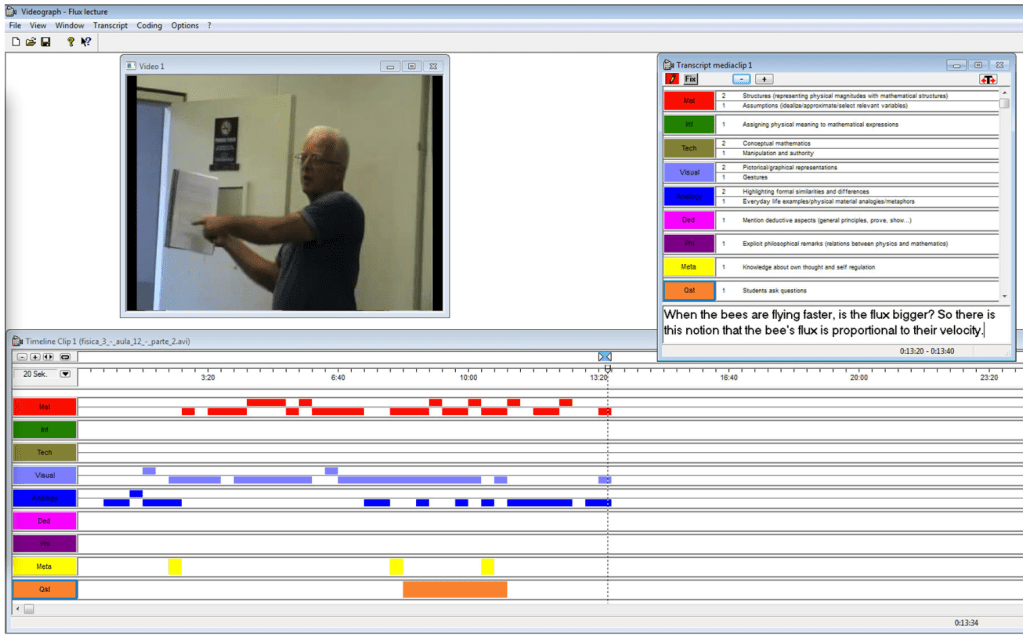
In this project, a case study was carried out on electromagnetism and relativity lectures taught by a distinguished physics professor. An analysis of selected teaching episodes led to the identification of a set of categories that capture different strategies the professor used to highlight the structural role of mathematics in his lectures. This analytical framework may serve as a basis for comparative studies of instructional approaches regarding the role of mathematics in physics.
Paper: Framing the structural role of mathematics in physics lectures
Presentation: Research seminar PER group @ CU Boulder
 Ricardo A. S. Karam